The Village Dogs of Lombok and the long history attached to them.
When most of us think of a dog, we envision the same thing: an animal on the sofa, on a lead in the park, with a name and a bowl. This image is everywhere. In adverts, in films, on social media. It feels like the normal scenario.
However, that is not the case. Worldwide, this image describes only a minority of dogs — a highly visible, much-publicised minority, but a minority nonetheless. The vast majority of the world’s dogs live very differently. And their story begins long before our Western model of pet ownership.
01 What is a Village Dog?
The worldwide average, not the exception
Estimates suggest that around 75–80 % per cent of all dogs worldwide live freely or semi-freely:in villages, towns, on coastlines and fields. In academic circles, they are referred to as free-ranging dogs or village dogs. With a global dog population estimated at between 700 and 900 million animals, this means several hundred million dogs fall into a category that is rarely encountered in our Western perspective.
These are not lost or abandoned pets. They are dogs that have never been part of our Western model of pet ownership, and whose history began long before that model existed.
Pedigree dogs are not the global standard. The rest of the canine world lives differently. And much longer than we are aware of.
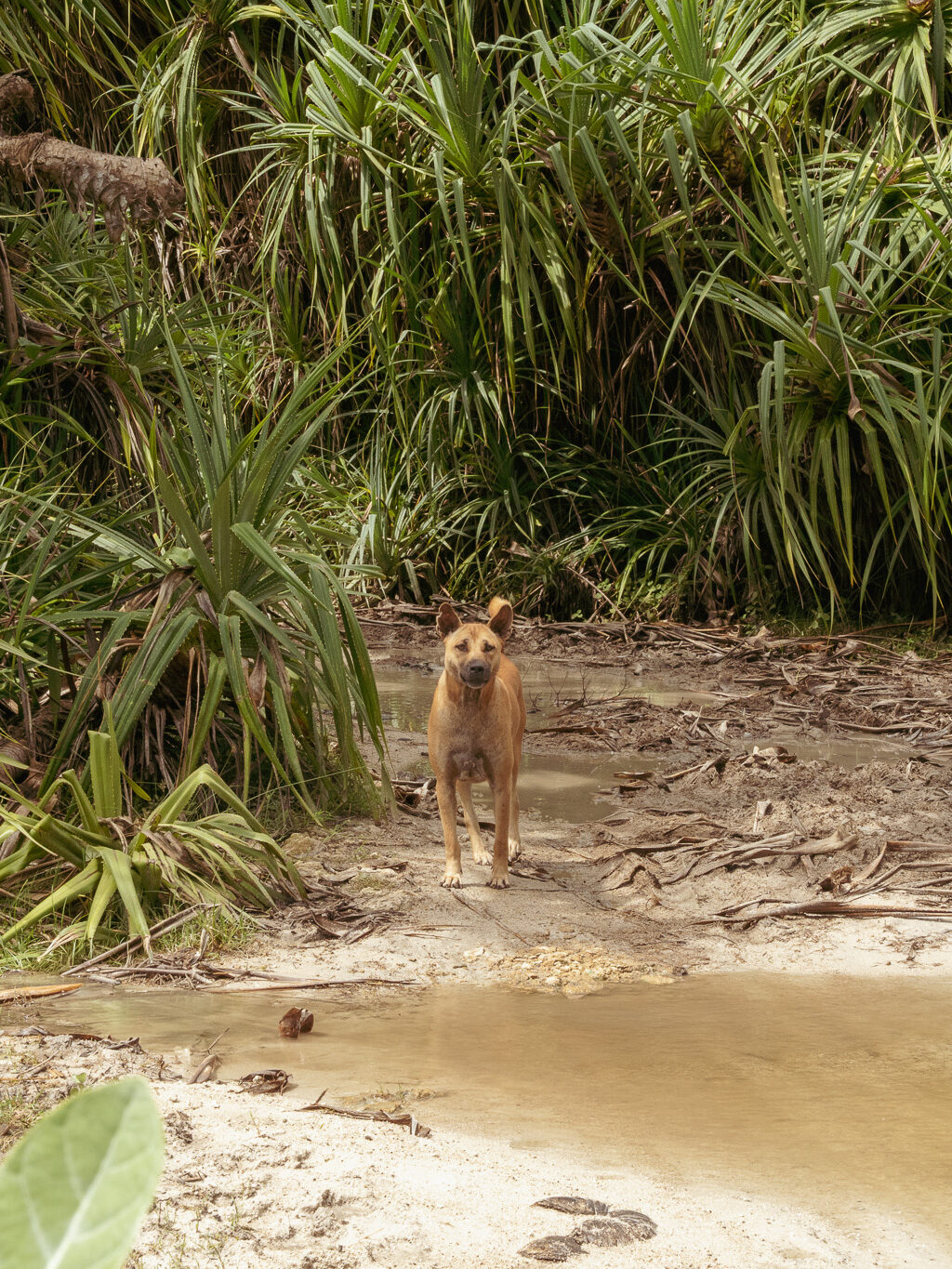
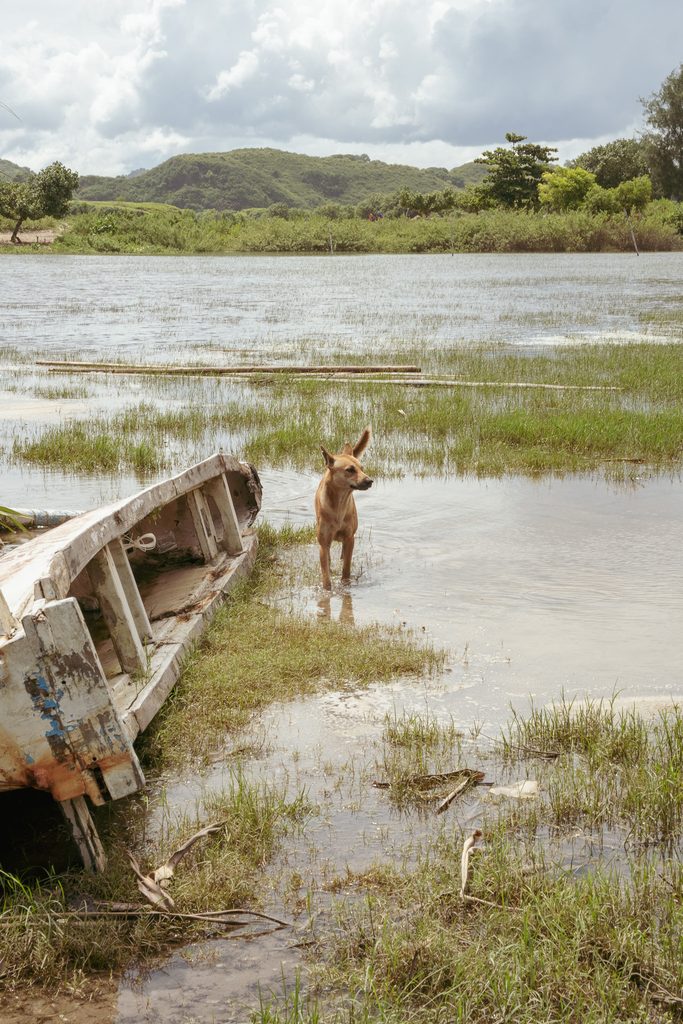
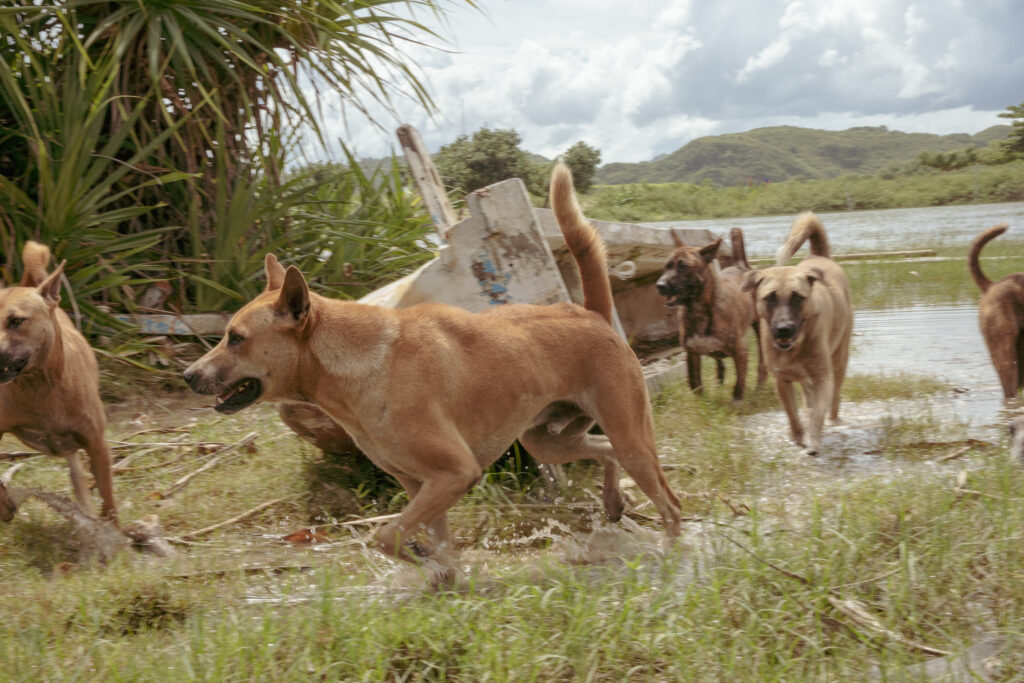
Free-ranging dogs. Free-roaming dogs on the coast of Lombok. Socially organised and adapted to their environment.
They are neither a pet nor a wild animal.No human being decides what they eat, how they reproduce or what they look like, and yet they live in close proximity to humans, make use of human environments and have adapted over thousands of years to living alongside us. In biology, this is known as commensalism:Animals that benefit from humans without being dependent on them. Social, adaptable, independent. That's exactly what the dogs on Lombok are like.
02 Not a mixed breed
Not a leftover category, but a landrace
Why the term ‘mixed breed’ falls short when it comes to Village Dogs.
‘Mixed breed’ sounds like a coincidence. Like a bit of everything, but with no origins, no history, no category of its own. It is precisely this question – ‘What breed is that, actually?’ – that we hear often about the dogs on Lombok. It shows just how deeply rooted thinking in breeds is: if no recognised breed fits, people quickly end up labelling as ‘mixed breed’, as if that is a leftovers-category for anything that cannot be explained by a family tree.
Scientifically, however, there is an important difference. A mixed-breed dog is the result of cross-breeding between known breeds – a modern, random process with no deep-rooted regional history. A landrace is something different: a population that has developed over a very long period of time in a specific region, under natural selection, without any human intervention in breeding.
Many Village Dogs are not random crossbreeds, but native breeds – developed regionally and biologically distinct. This is not a euphemism, but a scientifically precise category.
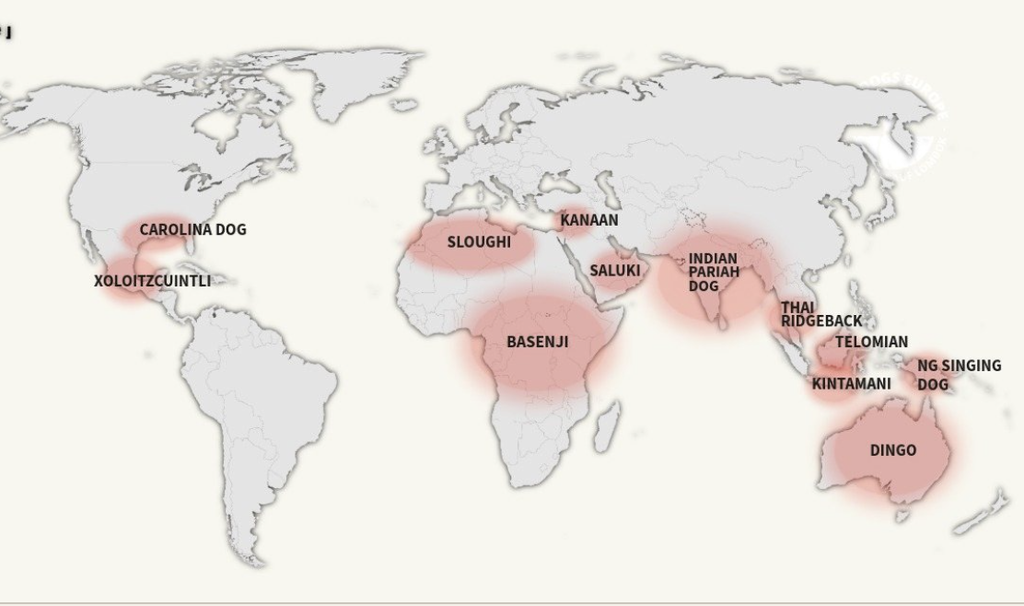
Older than modern breeds. Regional landraces from around the world, each shaped by its own environment, long before the breed standards of the 19th century were established.
And they are older than modern breeds.Most dog breeds, as we know them today, originated in the 19th century — when breeding became a social pastime and breed standards were established. Dogs themselves have been accompanying humans for at least 15,000 years. Many populations that have developed regionally follow the same principle: natural selection, a specific climate, and no planned breeding — from the Basenji to the Indian Pariah Dog and the Dingo.
03 From Wolf to Village Dog
What's between domestication and a pedigree
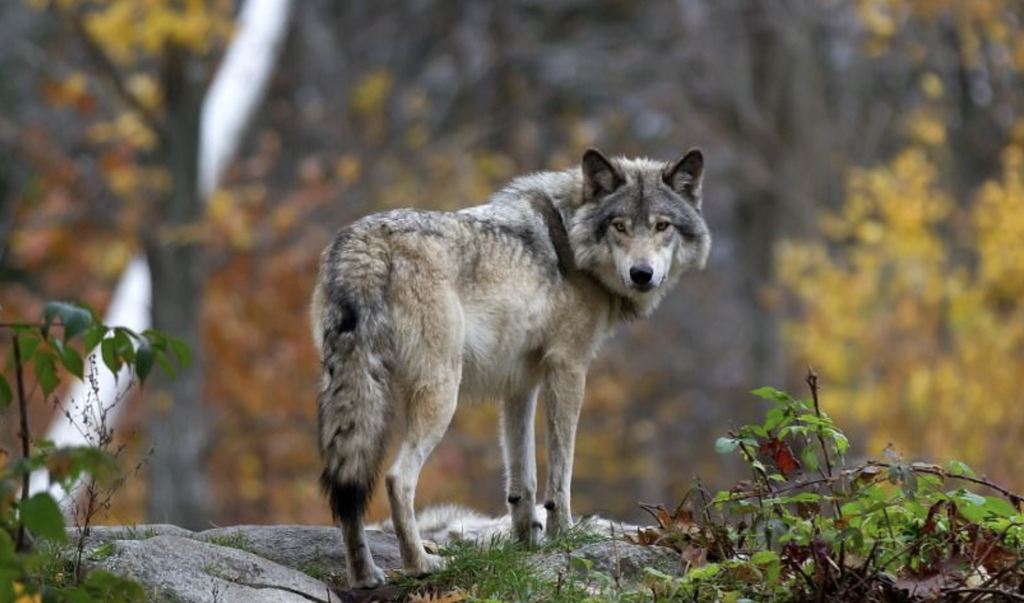
From the Chihuahua to the dingo, from pedigree dogs to the Lomdog, all dogs are descended from the same species: Canis lupus, the grey wolf.
Domestication began at least 15,000 yearsago, long before the beginnings of agriculture. How exactly the process took place remains unclear until today — theories include deliberate taming, random mutations leading to reduced shyness, or wolves simply domesticating themselves in the vicinity of human settlements because it was to their advantage.
Domestication fundamentally alters an animal: flight and defence behaviours are reduced, whilst proximity to humans increases. Village Dogs exhibit these characteristics — but were never subsequently shaped further through selective breeding. They occupy a biologically interesting position: domesticated enough to live alongside humans, yet wild enough to continue being shaped by natural selection.
This process did not result in a single uniform type, but rather a spectrum:
wolf
Wild animal, never domesticated, actively avoids humans.
Domestic dog
Shaped by domestication and breeding, lives with humans.
Village Dog
Domesticated but living freely – neither pet nor wild animal.
Feral dog
Former domestic dog, reverting to its original form without human intervention. Best-known example: the Dingo.
The Shared Origin. All dogs are descended from Canis lupus , the grey wolf.
Species, Subspecies, Breed
Three terms that are often mixed up. A Species A species comprises all the offspring of common ancestors that are capable of interbreeding - Canis lupus is a species. A Subspecies is a genetically distinct group within that species: Canis lupus familiaris, to which all domestic dogs belong — pedigree dogs as well as village dogs. Finally, a Breed is a category defined by humans within this subspecies, created through selective breeding. A Labrador is a breed. A Lomdog is not.
The Bottleneck
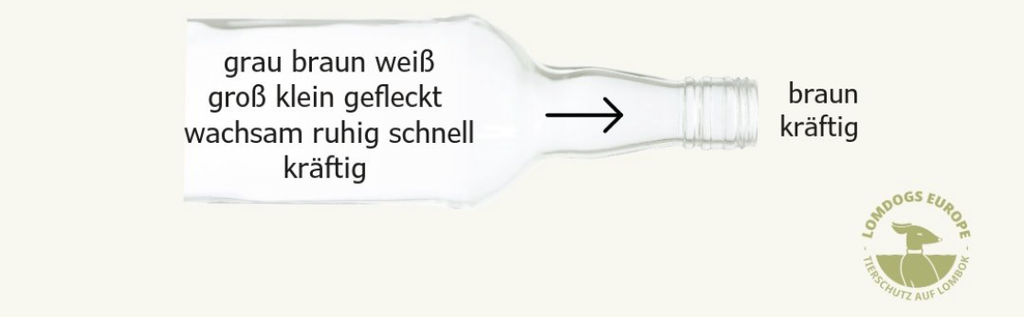
Intensive breeding acts like a bottleneck: always the same few dogs are used as breeding stock, traits are reinforced at the expense of genetic diversity, and populations are isolated in closed lines. Genetic studies show two successive bottlenecks in pedigree dogs — one caused by domestication, and another, significantly more severe one, caused by the development of breeds in the 19th century. Village dogs do not exhibit this second bottleneck.
The Bottleneck What fits through the narrow neck determines everything that follows. What does not fit is lost.
Where the Lomdogs are
Village dogs such as the Lomdogs are scientifically classified as Canis lupus familiaris — the same subspecies as the Labrador. However, this classification says little about their history. Their gene pool has never been systematically narrowed; natural selection has been at work, not human planning. They are therefore closer to the original domestic dog than any modern breed and form part of a regional history that began long before modern breed standards were established.
04 The Long Journey to Lombok
South-East Asia and the story that leads all the way to Lombok
The Lomdog and the Labrador share the same scientific name. But their histories could not be more different: one is thousands of years old, shaped by natural selection. The other is just 200 years old — and bears the genetic consequences of this.
The history of the Lomdog does not begin on the streets, but on the sea routes of South-East Asia, a region that has played a key role in the history of the dog for thousands of years. From here, early dogs spread across the archipelago alongside humans: across the ocean, by boat, along the major migration and trade routes.
And this is where Lombok comes into the picture. The island lies in the heart of the Lesser Sunda Islands — exactly where important migration and trade routes once ran through the archipelago. For early humans, Lombok was not a remote outpost, but part of a vast network of islands, ports and sea routes. It is quite possible that the dogs of Lombok are descendants of those dogs that once arrived in the region with early seafarers.
05 Current Research Status
What we know and what we don’t
As fascinating as the story is, not everything has been clarified. And that is precisely what makes this field of research so interesting. To date, genetic study on the dogs of Lombok has been published.The link to the early seafarers remains a scientifically plausible hypothesis, but not a proven fact. We are not recounting a legend of origin here, but rather the honest state of our knowledge.
Genomic research into free-roaming dogs is still in its infancy overall. What can be said, however, is this: The Lomdogs are part of a regional history that began long before modern breed standards, and they are closer to the original domestic dog than any modern breed.
Support the Lomdogs
With your donation, you’ll be helping street dogs on Lombok. Through neutering, medical care, rehabilitation and assistance for injured dogs in need.
They are neither a pet nor a wild animal.No human being decides what they eat, how they reproduce or what they look like, and yet they live in close proximity to humans, make use of human environments and have adapted over thousands of years to living alongside us. In biology, this is known as commensalism:Animals that benefit from humans without being dependent on them. Social, adaptable, independent. That's exactly what the dogs on Lombok are like.
Free-ranging dogs. Frei lebende Hunde an der Küste Lomboks. sozial organisiert, an ihre Umgebung angepasst.
Pedigree dogs are not the global standard. The rest of the canine world lives differently. And much longer than we are aware of.
Scroll to Top
Bleib auf dem Laufenden
Newsletter abonnieren
Neuigkeiten aus Lombok – Rettungen, Kastrationen und Updates zu unseren Hunden direkt in dein Postfach.